|
I'm not sure how long the 3rd-line for throttle control has been
around, but this article from the August 1957 edition of American
Modeler seems to suggest that it was introduced formally around time
of the 1957 model hobby industry trade show in Chicago - maybe a few
years before. There in an exhibitors' booth was a special bellcrank
featuring a three-wire control line system offered by the J. Roberts
Model Manufacturing Company, of Baker, Oregon.
Third Line Theme
The scene is the big annual trade show for the model-hobby industry
in Chicago. Three large halls are jammed with exhibit booths of new
plane, train, and boat kits, engines (glow) and motors (d.c.),
accessory and supply materials.
Sauntering about are fat-cat distributors and their coveys of
salesmen, rival manufacturers, solemn-looking designers checking the
other guy's brainstorm -and almost lost in the vast crowd, a few
build-it-yourself control line modellers.
Although outnumbered a hundred to one, it's easy to spot the yo-yo
fans. All you have to do is plant yourself in front of the small
display by a small concern from a small town in Oregon. This booth
features "Flight Control;" a three-wire control line system offered
by the J. Roberts Model Mfg. Co., of Baker, Ore.
Here come some CL'ers; quickly come their comments. "Hey, look at
that landing gear retract!" "Now that's what I call a real sharp
motor control . . ."
Etc., etc., etc. You get the idea.
 What
is this third line deal that's the theme of J. Robert "Bob"
Smurthwaite's pitch? Bob describes it as "a mechanical
triple-control connection in which three wires can be selectively
manipulated while an equalizing pull or tension is exerted on all
three." What
is this third line deal that's the theme of J. Robert "Bob"
Smurthwaite's pitch? Bob describes it as "a mechanical
triple-control connection in which three wires can be selectively
manipulated while an equalizing pull or tension is exerted on all
three."
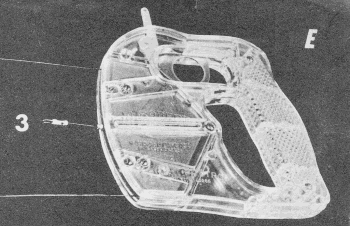
Translated from the Patent Office lingo it means you move the
Roberts Flight Control handle (photo E) like any standard Ukie
handle for "Up" and "Down"; at the same time you can trigger a third
line back and forth. Different, claims JRS, is the fact that the
centrifugal pull of the airplane in flight is divided among the 3
control lines which share equally the pull load.
System consists of three lines (which you provide), the handle and
the "Plane-Unit" (photo A).
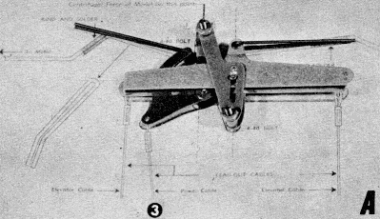 Lines
hook up and detach in conventional manner for storing on any
standard reel. Most modellers are surprised to find no springs in
the set-up. Reason; a doubled leverage mechanism within the handle
compensates for every action of the plane-unit regardless of the
manoeuvre or control operation. Lines
hook up and detach in conventional manner for storing on any
standard reel. Most modellers are surprised to find no springs in
the set-up. Reason; a doubled leverage mechanism within the handle
compensates for every action of the plane-unit regardless of the
manoeuvre or control operation.
Consequently, as Smurthwaite points out, it requires very little
line tension to maintain full control. As a result solo flight
operations are possible. In fact, the first motor-speed control
flight with the experimental unit was a I-man deal from hooking up
the lines, starting the engine, walking to the center of the circle,
then taking off the model. A spring held the motor speed restrictor
at low when the lines were slack.
This original test plane was a scale model of the Danish KZ-3 light
plane. The 5-pound, 54" wingspan model used a Madewell .49 on
ignition. An exhaust rotary restrictor had been installed in a stack
extension. After 8 years of flying Bob's first all-aluminium
plane-unit is still in good condition. Its bulkiness has been cut
down in the latest version. Final tests are near completion on a
small one for use on planes with motors up to .15 cu. in.
displacement. Regardless of the size of the plane-unit or model, the
one size handle works with all.
 Ron
Moulton, noted English designer, reported to Bob that "the great
revelation was that the control can be set and left alone. We had
been under the impression that it would be essential to maintain
finger tension on the 3rd line to retain engine setting, but in
fact, this is only required when ... (one) blips the motor ... " Ron
Moulton, noted English designer, reported to Bob that "the great
revelation was that the control can be set and left alone. We had
been under the impression that it would be essential to maintain
finger tension on the 3rd line to retain engine setting, but in
fact, this is only required when ... (one) blips the motor ... "
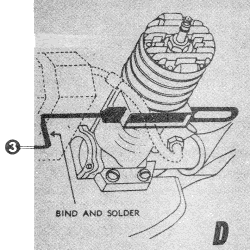
Shown in sketch D is the new style full-length "slide-restrictor"
Smurthwaite now recommends. This type which fits almost every size
and shape exhaust stack works more smoothly and wears longer with
its lengthened, edge surfaces. You make this by drilling starting
holes in the saw blade "slide" material and filing out the open
"port." It is best to grind and fit the blank slide to the necessary
incisions and tracks that you make in the exhaust stack before
drilling and porting the slide. Your motor, naturally, starts each
time with restrictor slide back in open, full-speed position.
The Oregon manufacturer sees the Navy Carrier, the new Air Force
Rocketry event (AM, pg 42, 2/57) and rat racing as logical places
for his units. Beyond that he thinks motor speed control and wheel
brake possibilities will stimulate greater activity in all phases of
control line flying be it sport or competition.
"In recent years," declares JRS, "precision aerobatic events have
been won by flyers who enter large models with stunt flaps in the
wing. A smaller precision-stunt model utilizing Flight Control will
wrap up more points than ever before possible with the following
advantages: The necessity of stunt-flaps to perform those square
comers can be eliminated by the combination of a full power surge
and up/down elevator control at the same moment to snap the plane
around sharply. Smaller models can be slowed to a smooth cruising
speed between each manoeuvre to allow the judges more time to record
manoeuvres.
 "By
smaller model, I refer to a model without stunt-flaps with a span
between 38 and 46 inches and a wing area from 320 to 450 square
inches." "By
smaller model, I refer to a model without stunt-flaps with a span
between 38 and 46 inches and a wing area from 320 to 450 square
inches."
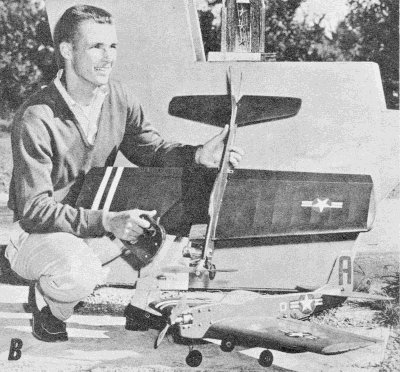
Production-line control units were first used at the Dallas National
Meet last July. Donald Storner (photo B), 15, of Belleville, Ill.,
won first in Junior Navy Carrier using Flight Control to operate a
Bramco throttle on a Fox 35 motor. His friend from Belleville,
16-year-old John Corrough, won second in Senior Carrier event with
the same combination - both flew J. Roberts "Sabre" models equipped
with their own version carrier-hooks. John's model is shown on
ground in photo B.
Glen Magree of Cleveland took first in Senior Carrier using Flight
Control to operate a Roto-valve on the Fox 59 in his scale model
"Bearcat."
Besides the items mentioned JRS says his system can be utilized to
operate landing flaps, carrier-arresting hooks, bomb-bay doors and
racks and related mechanism to drop any desired number of bombs at
any time from any position including dive-bombing, also multi-engine
control, landing lights, pilot ejection seat, even change of
propeller pitch.
 Bob
is an old-time modeller having been a fan of this magazine since its
Bill Barnes days. He recalls building from our early plans Gordon
Light's 1935 Wakefield winner and Al Judge's '36 championship plane
as well as many of Alan Booton's scale jobs. As owner of one of the
first Ohlsson .23 power plants, he scaled down Ben Shereshaw's
Cavalier to take that engine. Bob
is an old-time modeller having been a fan of this magazine since its
Bill Barnes days. He recalls building from our early plans Gordon
Light's 1935 Wakefield winner and Al Judge's '36 championship plane
as well as many of Alan Booton's scale jobs. As owner of one of the
first Ohlsson .23 power plants, he scaled down Ben Shereshaw's
Cavalier to take that engine.
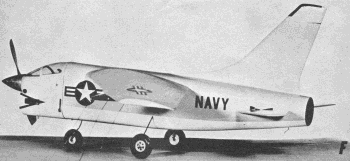
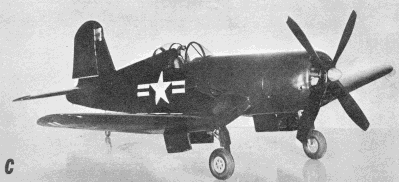 Bob's
forthcoming kit models includes a scale-line prop-driven Crusader
(photo F) for Navy Carrier and other racing events. Span is 28",
length is 30"; it takes .29 to .35 motor. Original has carrier-hook;
complete horizontal tail surface moves like the full scale job.
All-balsa moulded construction to be featured; kit ready by
mid-summer. Later he promises the scale Corsair for Fox 59 with
motor-speed (photo C). Model has retractable landing gear, including
tail-wheel, controllable rudder offset, droppable carrier-hook-all
operating through one handle. Bob's
forthcoming kit models includes a scale-line prop-driven Crusader
(photo F) for Navy Carrier and other racing events. Span is 28",
length is 30"; it takes .29 to .35 motor. Original has carrier-hook;
complete horizontal tail surface moves like the full scale job.
All-balsa moulded construction to be featured; kit ready by
mid-summer. Later he promises the scale Corsair for Fox 59 with
motor-speed (photo C). Model has retractable landing gear, including
tail-wheel, controllable rudder offset, droppable carrier-hook-all
operating through one handle.
|
 This
article is reproduced from Kirt Blattenberger's website
This
article is reproduced from Kirt Blattenberger's website